On your own, or with someone. Everything else you can change later.
Play alone
Pick a picture and solve it at your own pace. Your run is saved if you stop.
Play with friends
Send one link; they join in a click, no account, no download. Live rooms are in beta — if one will not open, the ghost race works with nobody else online.
Nearly every piece has a near-twin at this size. Most pieces carry some texture.
Par is the time your score is measured against at that size. The rest is measured from the picture itself: how many pieces have a near-twin by colour once it is cut.
What the picture shows
A red fox lies curled in fresh snow just right of centre, its tail wrapped round its body and snowflakes on its fur, looking straight at you. Behind it stands a birch wood: white trunks marked with black, and a dense tangle of frosted twigs and grass. Two thick birch trunks rise on the right, where the low sun shows through in the top corner. A branch of red rose hips capped with snow reaches in from the left, and smooth snow covers the bottom third.
Solving Fox in the Snow
The fox and the red berries are easy at any size; everything else is white. At 50 pieces about 8 pieces in 10 already have a near-twin, because snow, birch bark and frost share one white. The frosted twigs give most pieces some texture, but it is the same texture all through the wood. The open snow at the bottom is the plainest part.
Place the fox first, from its face out to the tip of its tail. Then the red rose hips on the left. Build the two big birch trunks on the right next, using their black marks, then the thinner trunks behind. Sort the rest by how much is in a piece: dense twigs belong higher up, a few stalks belong just above the snow line, and smooth white is the snow at the bottom.
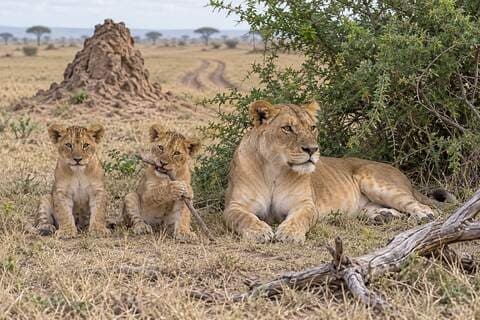
Fox in the Snow shares the hard end of the animal set with Lion Pride: it has the most look-alikes of the six at 50, 100 and 500 pieces and comes second at 200 and 1000. Its snow gives it the most plain pieces of the six: about 2 pieces in 10 at 1000 pieces, where none of the other animals reaches 1 in 10.